
Shanghai, 10 July 2025
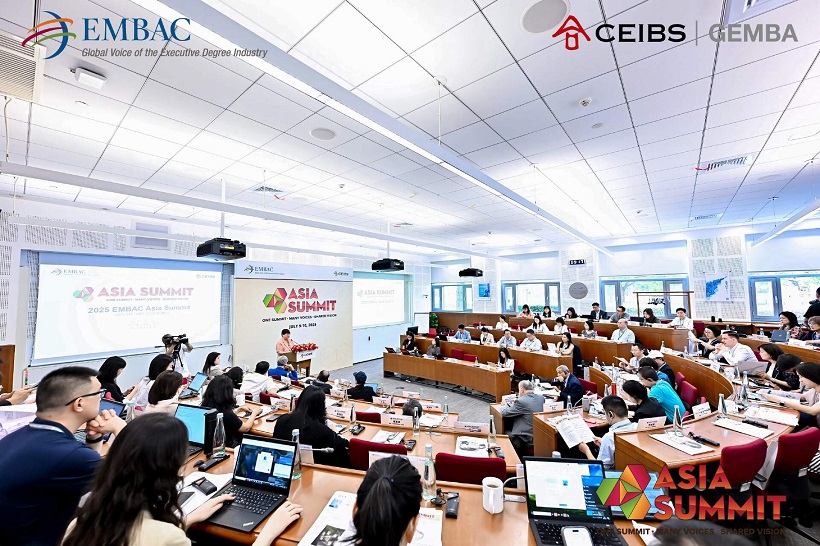
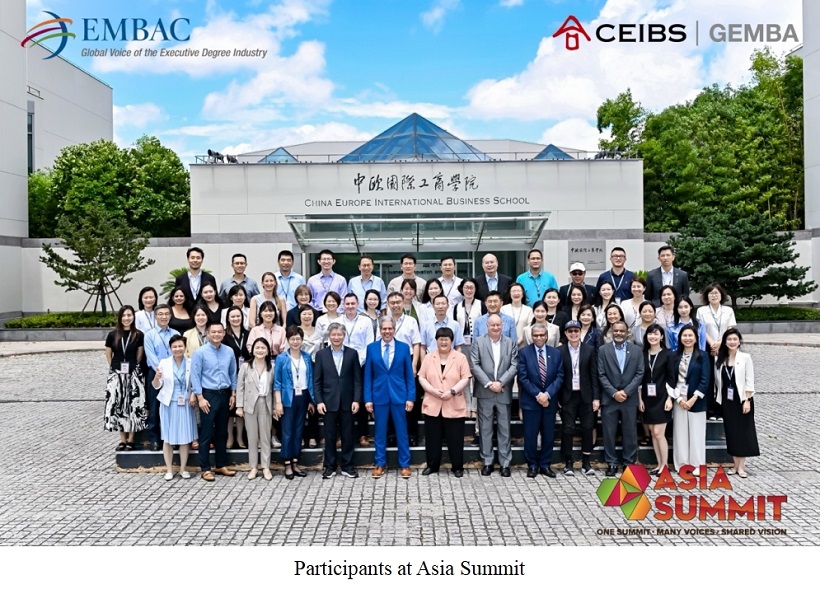
The EMBAC Asia Summit 2025, a significant gathering of the world’s foremost business education leaders, concluded successfully yesterday at the China Europe International Business School (CEIBS) Shanghai campus.
Held over two days (9-10 July), the summit convened academics from elite global business schools, alongside senior executives and industry leaders. Their collective focus: examining critical challenges and emerging opportunities at the forefront of management education, and exploring innovative practices shaping its future.
This high-level forum transcended institutional boundaries, serving as a platform for decision-makers from premier business schools to engage in substantive dialogue. The event marked a concerted effort to forge collaborative pathways in executive degree education, moving decisively towards building a cohesive learning community for the future.
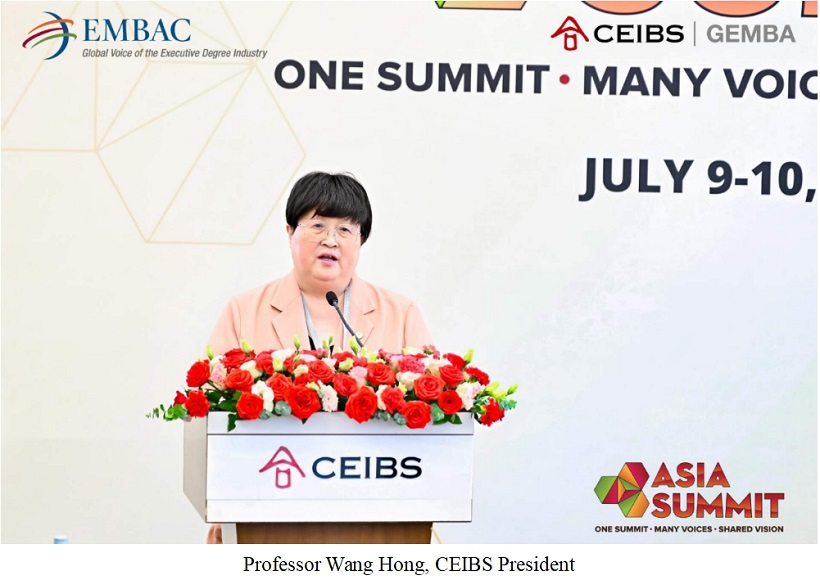
During her welcome address, CEIBS President Wang Hong stated that current changes in the global business landscape are profoundly reshaping corporate expectations of leadership talent, necessitating accelerated transformation of executive degree education.
"Internationalisation is fundamental to CEIBS' identity. We remain committed to our role as a bridge fostering collaboration in global business education. Looking ahead, CEIBS stands ready to work with partners worldwide to build a shared knowledge community, cultivate the next generation of innovative talent, and collectively shoulder the defining responsibilities of our era,” President Wang concluded.
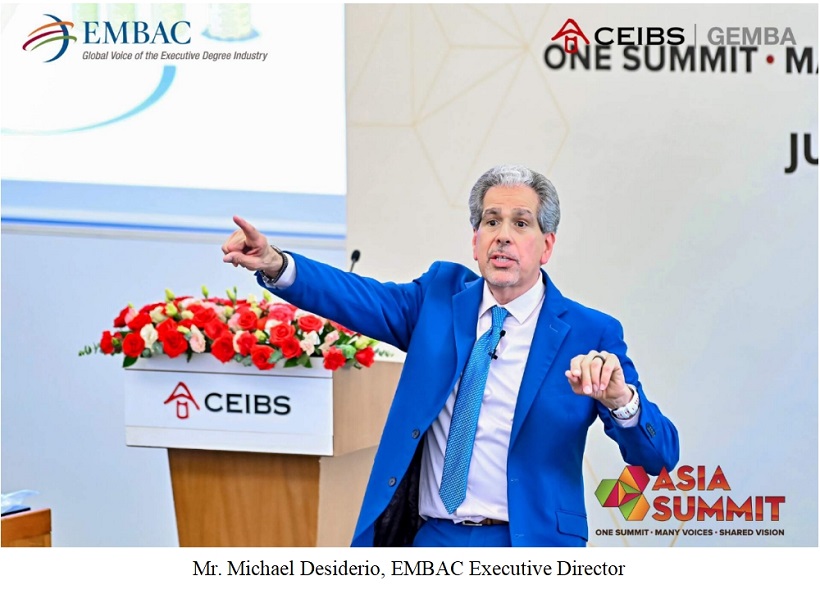
EMBAC Executive Director, Michael Desiderio, initiated proceedings with a brief networking exercise designed to foster immediate connection among delegates. Mr. Desiderio emphasised the summit’s aim to harness collective expertise, strengthen community ties, and deliver unique value to the global business education sector.
In his keynote, "A Global View of Executive Degree Education: What the Data Reveals," Mr. Desiderio presented research indicating a fundamental shift in student expectations. "Learners today seek more than traditional knowledge transfer," he stated. "They increasingly view the business school experience as a powerful engine for profound personal transformation and becoming a 'better self'." This focus on personal growth, he argued, is reshaping the core value proposition of business education.
The data revealed divergence between learner preferences and institutional delivery: hybrid learning models are globally favoured, while traditional face-to-face instruction ranked lowest among student choices. Mr. Desiderio noted that while face-to-face teaching is still one of the primary instruction methods hybrid is the second most of offered, showing schools are moving to meet changing market needs.
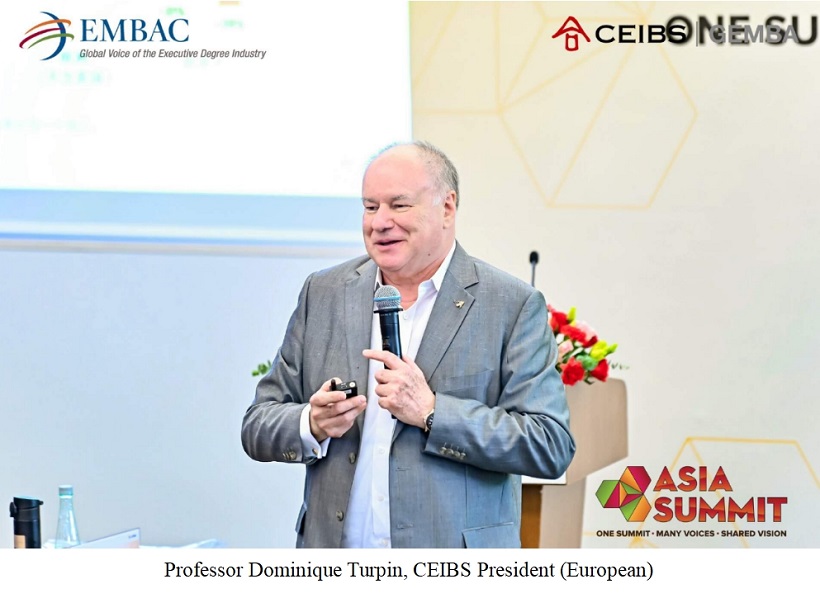
Following this, CEIBS President (European) Dominique Turpin delivered a keynote speech entitled “Trends impacting Asia and Beyond” during which he outlined four key macro trends currently shaping global business education.
First, global application rebound driven by demand for domestic and specialised programs. Second, student mobility shifts increasingly shaped by geopolitics, cost, and policy. Third, declining Chinese interest in US study; China (with India) remains a top global student source. Forth, evolving employer priorities: AI proficiency and strategic thinking now supersede cultivating a global mindset.
To ensure the continued advancement of business education, Prof. Turpin called for business schools to adapt strategically, build strong regional influence, adhere to international standards, and pursue innovation in pedagogy and collaborative models.
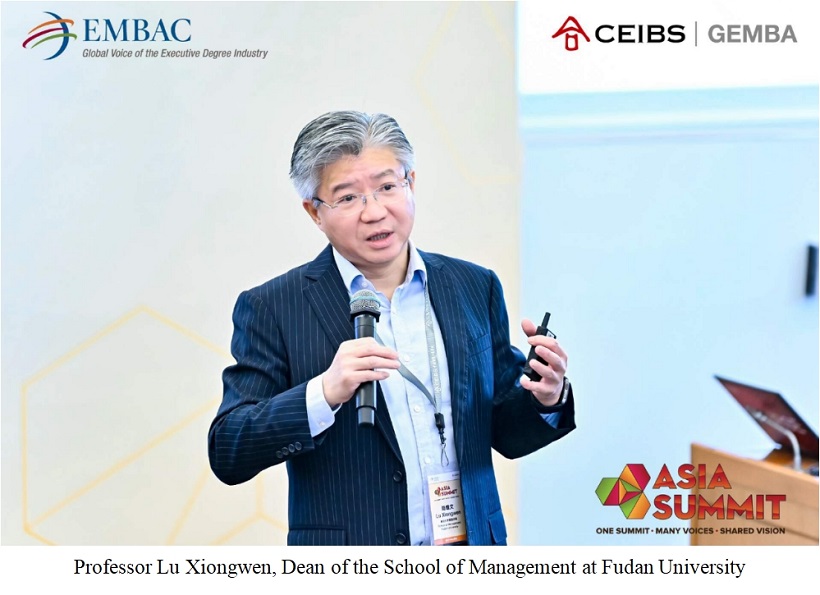
Lu Xiongwen, Dean of the School of Management at Fudan University, delivered a keynote speech titled “The Chinese View of the MBA/EMBA Education Market” during which he reviewed the history and current landscape of business education in China, noting that today, over 90% of Chinese universities have established management or business schools, totaling nearly 800 institutions.
He emphasised that the sustained growth of China’s economy, the surging momentum of Chinese innovation, and the rapid development of a new generation of young faculty in China have together created a formidable force in management education. These factors, intertwined with vast market demand and a rich supply of high-quality educational resources, have opened up vast potential for the development of EMBA and MBA programmes in China.
Prof. Lu advocated for systemic reform, urging a move away from outdated models that focus solely on research papers towards new evaluation standards that are closely aligned with real-world challenges. "The core of business school education," he asserted, "must integrate industry practice with a mission to serve society." He further called for more flexible educational strategies to invigorate a new ecosystem for management education.
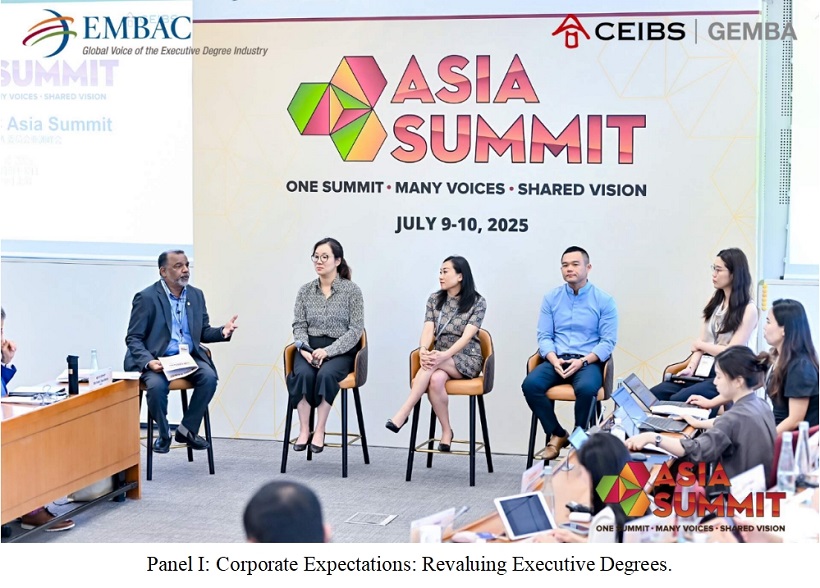
Panel I: Corporate Expectations: Revaluing Executive Degrees
Chaired by Dr. Bala Ramasamy, Professor of Economics and Associate Dean at CEIBS, the first panel sparked a dynamic exchange on evolving corporate demands for executive degrees. Senior HR leaders from Moët Hennessy Diageo China (Ms. Cai Yingling), Siemens Healthineers Asia Pacific & China (Ms. Li Jingqi), LinkedIn China (Mr. Zhang Fei), and Trip.com Group (Ms. Wang Si) provided cross-sector insights.
A key consensus emerged: amid accelerating Chinese corporate globalisation, businesses increasingly prioritise hiring entrepreneurial leaders with ambition and a propensity for challenging convention. Panellists urged business schools to demonstrate sharper industry acumen, offering bespoke short courses tailored to specific sectors and scenarios. They advocated dismantling disciplinary silos to achieve deeper integration between academia and industry, ensuring knowledge directly addresses practical challenges.
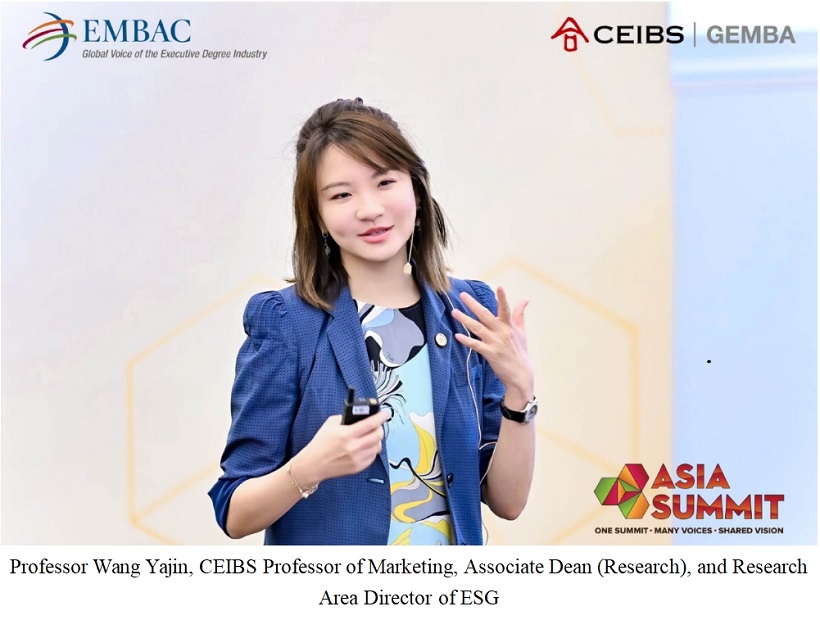
In a speech titled “Branding for the Future: Navigating Consumer Polarisation, Redefining Strategy”, CEIBS Professor of Marketing, Associate Dean (Research), and Research Area Director of ESG Wang Yajin noted that the trend of consumer polarisation has become a global phenomenon. Using well-known brands such as MINISO and VIVO as examples, she pointed out that the high-end and low-end market segments are expanding rapidly, while the middle market is increasingly being squeezed out.
Premium brands must anchor themselves in deep consumer insight, offering unique value propositions and exceptional experiences to capture share," she stated. "In the value segment, success hinges on delivering extreme price-performance, fostering differentiation, and building barriers to entry to avoid commoditisation.
Technological advances, she noted, have driven customer channel-switching costs towards zero. Brands must therefore trigger consumption across integrated scenarios, shifting from one-way communication to interactive co-creation. "This necessitates a fundamental paradigm shift from B2B to truly customer-centric (C2B) business logic," Professor Wang concluded. "The depth of consumer understanding, the quality of engagement, and the resilience of long-term relationships will distinguish brands capable of sustainable, cyclical growth."
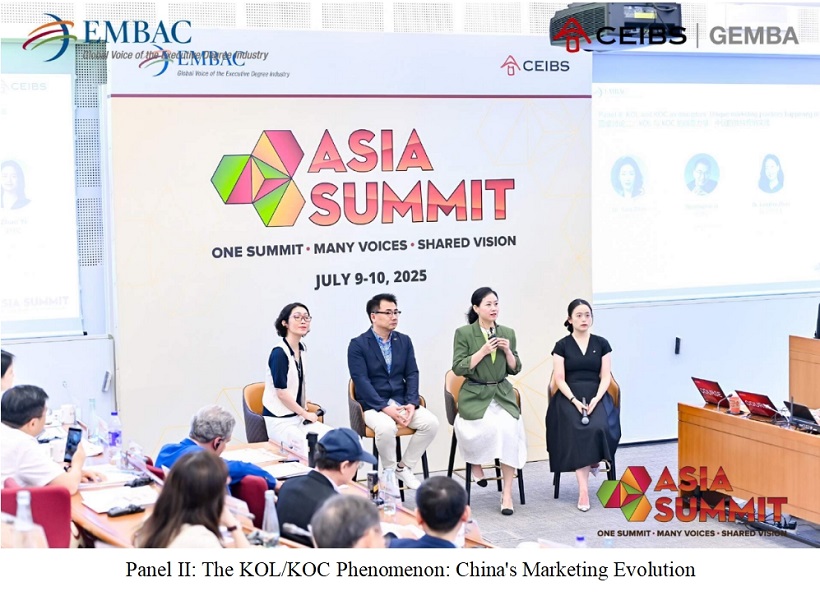
Panel II: The KOL/KOC Phenomenon: China's Marketing Evolution
Moderated by Zhao Ying, Editor-in-Chief of WhichMBA.net, the second panel examined the disruptive power of Key Opinion Leaders (KOLs) and Key Opinion Consumers (KOCs). Featuring experts from Ogilvy China (Ji Weijia, Chief Digital Officer), digital strategy (Zhao Linghui, Author), and Yingxiang Network Technology (Zhao Yi, CEO & ex-Xiaohongshu founding member), the discussion highlighted unique Chinese digital marketing practices.
Panellists concurred on a profound industry shift: from centralised to decentralised influence; from over-produced to authentic content; from one-way broadcasting to two-way sharing; from rational appeal to emotional resonance; and from uniform professionalism towards distinctive individuality. "Content must resonate through authentic language, relatable creator personas, and genuine substance," the panellists emphasised. "This is paramount for standing out in the digital sphere."
On the second day of the summit, EMBAC Executive Director Michael Desiderio resumed the podium to synthesise core insights and material consensus established during yesterday’s proceedings, thereby setting a definitive tone for the second day’s agenda. Reflecting on Professor Dominique Turpin’s emphasis on human-centric organisational structures and Dr. Wang Yajin’s analysis of consumer demand for efficiency, Mr.Desiderio underscored the Summit’s core conviction: that profound intellectual exchange and human connection spark enduring brilliance.
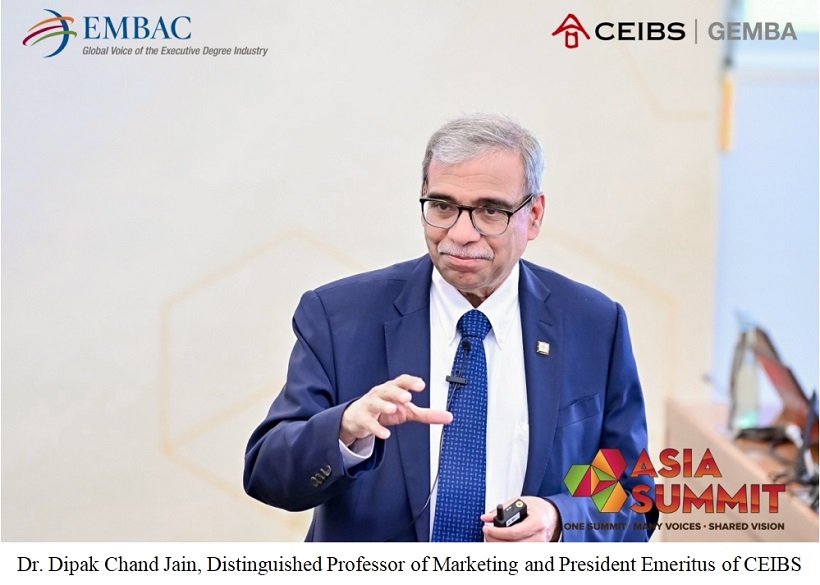
The proceedings commenced with a keynote address by Dr. Dipak Chand Jain, Distinguished Professor of Marketing and President Emeritus of CEIBS. Dr. Jain traced the evolution of graduate management education: from its foundational phase prior to the 1960s, focused on commercial relevance through case studies of "war stories"; through a subsequent era prioritising academic rigour via analytical modelling; to the present century’s imperative for societal impact. He noted the integration of business ethics and Environmental, Social, and Governance (ESG) principles into experiential learning, cultivating holistic leadership. Dr. Jain also asserted that talent remains the wellspring of knowledge creation and dissemination. The dynamic interplay between faculty and students, he contended, pushes intellectual boundaries and fosters innovation. Future executive degree education, he argued, must prioritise innovative thinking, cross-cultural fluency, and sustainable leadership to navigate global complexities.
Panel III: Curriculum Design Amidst Market Flux
A robust panel discussion, moderated by Ms. Nicole Tee, Director of the MBA Programs Office at NUS Business School, explored "Curriculum Design in a Shifting Market Landscape". Distinguished participants included Professor Ma Li, Vice Dean of Guanghua School of Management, Director of EMBA Center and Professor of Department of Organization and Strategic Management at Peking University; Ms. Nicole Ni, Assistant Dean of Research Institute at Shanghai Advanced Institute of Finance(SAIF) and Director of the SAIF Finance MBA Program; Dr. Bo Shao(Paul), Head of Executive Education Department at Fudan School of Management, Managing Director of Wash U - Fudan Executive MBA Program, Director of HK City U - Fudan DBA Program; and Mr. Tracy Zhang, Deputy Director of the MBA Programme at Cheung Kong Graduate School of Business(CKGSB).
Panelists concurred that post-pandemic challenges ? market saturation and evolving clientele demanding greater return on educational investment ? compel business schools to forge distinctive value propositions. Peking and Fudan Universities leverage their comprehensive research ecosystems, fostering interdisciplinary faculty collaboration to cultivate strategic foresight. SAIF champions "financial literacy for scientists," utilising real-world SJTU case studies to immerse students, harnessing diverse student backgrounds to create cross-disciplinary synergies, and nurturing executive talent for science-led enterprises. CKGSB, meanwhile, focuses intently on family business successors, redefining product offerings around holistic lifecycle experiences and enhancing client engagement to support enterprise development.
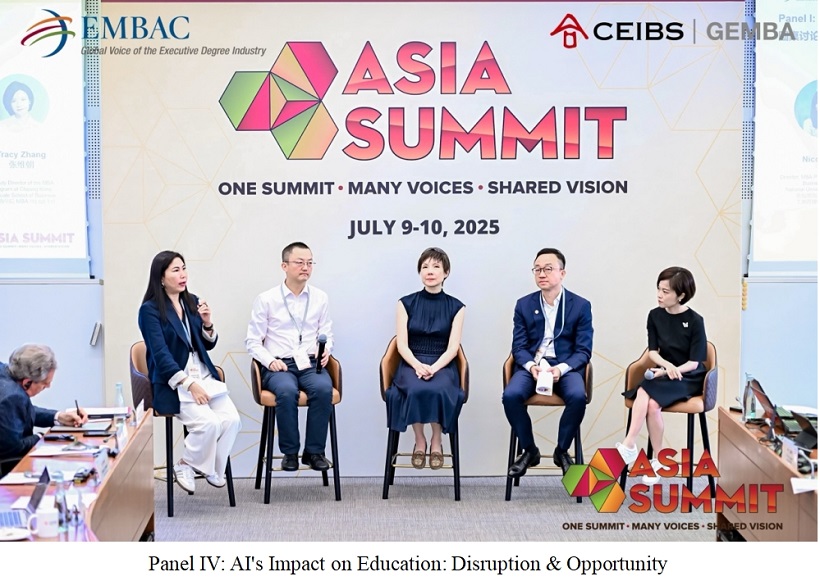
Panel IV: AI's Impact on Education: Disruption & Opportunity
The transformative potential and challenges of Artificial Intelligence (AI) in education took centre stage in a subsequent forum chaired by Ms. Catherine Xiang, Head of Marketing & Admissions for the NUS Business School EMBA Chinese Program. Participants ? Mr. Victor Zhang, Co-Founder of VIKID; Mr. Susan Ren, Chief Strategy Officer of Tezign and Vice Chairman of the CEIBS Tezign AI and Business Innovation Initiative; Ms. Zhang Ying, Founder and CEO of Global EduMind AI; and Mr. Tang Qi, Founder of Meipian, an AI Companion Robot Entrepreneur and Former Senior Executive at Huawei ? offered trenchant perspectives.
They observed AI's widespread adoption in pre-school and primary education, contrasting with academia's more measured approach. Nevertheless, universities are piloting AI applications, such as automating admissions inquiries and exploring credit recognition for AI-enhanced online learning. Crucially, the forum emphasised AI as an "enabling tool" serving humanity. Individuals possessing interdisciplinary agility and a commitment to lifelong learning, they asserted, will remain indispensable and thrive amidst technological disruption. This insight, they noted, holds profound implications for future talent development.
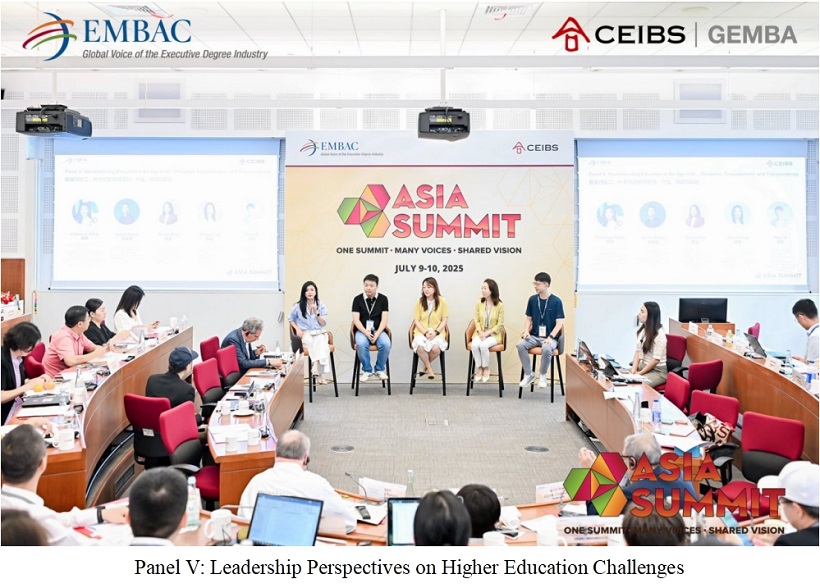
Panel V: Leadership Perspectives on Higher Education Challenges
The Summit culminated in a leadership roundtable of singular distinction, featuring Dr. John A. Quelch, American President and Executive Vice Chancellor of Duke Kunshan University; Dr. Kai-Lung Hui, Acting Dean of the HKUST Business School; and Dr. Joseph Cherian, CEO&Dean of the Asia School of Business. Drawing upon their formidable international experience, the trio advanced strategies for developing globally minded, innovative, and socially responsible leaders: Expanding overseas partnerships to circumvent geopolitical constraints; Encouraging faculty engagement with industry to strengthen client-academic bonds; Researching indigenous management practices to unlock region-specific innovation. Their incisive, forward-looking dialogue provided a fitting conclusion to the proceedings.
Summit Impact
The EMBAC Asia Summit has established itself as a premier platform for global business education leaders, scholars, and practitioners. Its success significantly bolsters the internationalisation and innovative advancement of executive degree education across Asia. Participants expressed strong consensus on the need for continued high-level collaboration to shape the future of business leadership and propel global economic prosperity.